Meet Alex Nwoko
A decade of building the systems behind disaster risk & humanitarian response
There’s a particular kind of urgency that drives you when you’ve seen what happens when decisions are made without evidence. Early in my career, I watched communities suffer not because help wasn’t available, but because the information to direct that help simply didn’t exist, or existed in fragments scattered across spreadsheets that no one could piece together in time. I watched flood waters rise in displacement camps where no one had mapped the risk zones. I watched cash transfers reach the wrong households because targeting data lived in disconnected silos. I watched satellite imagery that could have predicted a drought sit unused while responders planned with outdated reports.
That experience planted a question I’ve been trying to answer ever since: What does it take to put the right information in front of the right people before a crisis becomes a catastrophe?
That question took me to Durham University on a Commonwealth Scholarship, where I studied risk and environmental hazards at the Institute of Hazard, Risk and Resilience. My research on social vulnerability indices wasn’t just academic, it was built in partnership with the Newcastle City Council Emergency Planning Unit, mapping physical and social vulnerability indicators for proactive emergency preparedness. That experience taught me something that has shaped every role since: the most sophisticated analysis in the world is worthless if it doesn’t reach the people who need it, in a format they can act on.
From Durham, I carried that conviction into Maiduguri, the epicenter of the Boko Haram crisis and one of the largest humanitarian operations in Africa. As Information Manager for the Shelter/NFI and CCCM Clusters with IOM, I built the cluster’s information management system from scratch, but I also saw that data dashboards alone weren’t enough. Displacement camps flooded every rainy season, and no one had the spatial risk analysis to anticipate it. So I built data-driven flood contingency plans and GIS vulnerability maps that changed how clusters prepared for seasonal hazards. That was the beginning of what I now think of as humanitarian systems architecture, where data analytics, geospatial analysis, and disaster risk reduction have to work together.
In Cox’s Bazar, the world’s largest refugee operation, I saw the same fragmentation in a different form. Cash-based interventions were growing rapidly, but the information systems behind them couldn’t keep pace, beneficiary targeting was disconnected from payment processing, and post-distribution monitoring was an afterthought. I designed the Cash-Based Intervention Information Management System (CBIIMS) for IOM, a five-stage workflow from beneficiary profiling through payment automation, while supervising the GIS unit producing maps for 29 camps and coordinating communication-with-communities data across 1,100+ radio listening groups. It was here I understood that geospatial tools, cash transfer systems, and humanitarian reporting aren’t separate disciplines, they’re parts of one integrated challenge.
In Ethiopia, those threads deepened further. I developed the UNICEF Information Management Strategy, deployed geospatial tools mapping drought response coverage and community vulnerabilities across conflict-affected regions, and served as data consultant for the Ethiopia Cash Working Group, leading the first-ever inter-agency post-distribution monitoring meta-analysis, designing financial services provider assessments across Tigray, and building the operational dashboards that tracked $3.2M in CERF-funded cash allocations reaching 185,000 beneficiaries.
Afghanistan became the culmination of all four pillars. Leading a $9.7M USAID-funded program, I led and managed the development and deployment of ReportHub for multi-cluster humanitarian reporting across 200+ organizations, the Humanitarian Spatial Data Center (HSDC) for multi-hazard geospatial analysis integrating earthquake, flood, and drought data, while developing data, evidence generation, and information management strategies for UN agencies and interagency coordination groups, including climate early warning platforms, anticipatory action frameworks, and Cash & Voucher Working Group analytics, all while navigating one of the world’s most complex operating environments under Taliban governance.
I’m not done building. The humanitarian sector is at an inflection point where AI, geospatial intelligence, climate science, and real-time data can fundamentally change how we prepare for and respond to crises, if we build the right systems and put them in the right hands. That’s what I do.
“His ethical, risk-informed, and forward-thinking approach makes him an invaluable leader in humanitarian geospatial information technologies and emergency response coordination.”
Abdon Trowonou
Operations Director, iMMAP Inc. Headquarters
Career
The Timeline
Information Manager, Shelter/NFI & CCCM Clusters
IOM Nigeria, Maiduguri, Nigeria
Built the cluster IM system from scratch, dashboards, factsheets, gap analysis, while developing data-driven flood contingency plans, GIS vulnerability mapping, and risk analysis products for one of Africa's largest humanitarian operations during the Boko Haram crisis.
Information Management Officer, Food Security Sector
FAO Nigeria, Maiduguri, Nigeria
Managed sector-wide reporting and partner coordination data for the food security response in northeast Nigeria, supporting gap analysis and response monitoring.
IM & CBI Data Officer
IOM Bangladesh, Cox's Bazar, Bangladesh
Designed the Cash-Based Intervention IM System (CBIIMS), supervised the GIS unit, and coordinated communication-with-communities data across 29 camps and 1,100+ radio listening groups in the world's largest refugee response.
Project Lead, COVID-19 Situation Analysis
iMMAP Bangladesh, Dhaka, Bangladesh
Led a team producing seven comprehensive analysis reports tracking the pandemic's cascading impacts, deploying the DEEP platform for AI-enabled secondary data classification and analysis.
Crisis Information Analyst
IOM Headquarters, Geneva, Switzerland
Designed knowledge management systems and crisis monitoring platforms at the global institutional level.
IM Specialist, Agriculture Cluster / Planning & Monitoring
FAO & UNICEF Ethiopia, Addis Ababa, Ethiopia
Developed the UNICEF Ethiopia IM Strategy, deployed geospatial tools for drought response mapping and community vulnerability assessment, and led the Ethiopia Cash Working Group's first inter-agency PDM meta-analysis and financial services provider assessments across Tigray.
Program Coordinator & Technical Advisor
iMMAP Afghanistan, Kabul, Afghanistan
Led a $9.7M USAID-funded program spanning all four pillars: ReportHub for multi-cluster reporting (200+ orgs), HSDC for multi-hazard geospatial analysis, climate early warning and drought monitoring platforms, anticipatory action frameworks, and Cash & Voucher Working Group IM support.
What Supervisors Say
“Alex has exceeded expectations as far as CBI is concerned. He has worked tirelessly to ensure a functioning system and trained and supported field staff and finance staff on systems strengthening.”
Lauren Pearson
Programme Manager, IOM Bangladesh
“His performance consistently demonstrated extraordinary technical ability, leadership, and innovation in support of data-driven cash programming.”
Samson Muradzikwa
Regional Social Policy Advisor (MENA), UNICEF
“He proved to be an invaluable member of the team. Mr. Nwoko is able to work with a high degree of independence and in multicultural environment. He is conscientious and results-oriented.”
Rafaelle Robelin
Shelter/NFI & CCCM Sector Coordinator, IOM Nigeria
“Alex is an invaluable asset to iMMAP Inc., not only in Afghanistan but on a global scale. His exceptional leadership, dedication, and problem-solving skills have consistently contributed to the success of the organization's mission. Given his capabilities and experience, Alex is well-prepared to take on the role of Country Representative in any iMMAP mission worldwide.”
Belo Mohammed
Country Representative, Afghanistan, iMMAP Inc.
“He has demonstrated the capacities required to take on international IM assignments. Alex has significant technical experience and related contribution to the improvement of IM tools and data collection.”
Michelle Hsu
Food Security Sector Coordinator, FAO Nigeria
“Alex is and has been a great value to the Afghanistan team and program. His commitment and dedication to the program have brought the program as a whole to the next level.”
Coen Gorter
Country Representative, Afghanistan, iMMAP Inc.
“Alex successfully supervised a team of professionals in developing accurate information management and GIS products, natural risk hazard analysis and multi-vulnerabilities maps.”
Rafaelle Robelin
Shelter/NFI & CCCM Sector Coordinator, IOM Nigeria
“Alex consistently goes above and beyond the responsibilities outlined in his TORs. Quality of work is always beyond expectation.”
Belo Mohammed
Country Representative, Afghanistan, iMMAP Inc.
“Alex is a hard working and reliable team member, he often goes above and beyond his ToR to meet mission requirements. He is a team player and pleasant to work with.”
Lauren Pearson
Programme Manager, IOM Bangladesh
“Alex possesses natural leadership capabilities. I recommend iMMAP to engage with Alex in a development path towards a senior leadership role.”
Coen Gorter
Country Representative, Afghanistan, iMMAP Inc.
“Alex consistently operates at the intersection of data, digital innovation and humanitarian emergency operational impact. His work reflects not just technical mastery, but innovation with strategic foresight. His ability to connect applied analytics with broader questions of equity, vulnerability, and governance sets him apart.”
Leslie Parker Odongkara
Coordinator, Food Security & Agriculture Cluster, FAO Afghanistan
Thought Leadership
Shaping the Practice of Humanitarian Data Systems
Beyond building systems, I contribute to the global discourse on how data, geospatial intelligence, and disaster risk science should be integrated into humanitarian decision-making, through academic presentations, university speaking engagements, and published analytical work used by UN agencies and humanitarian coordination bodies.
Information Management in Humanitarian Response Sector
Academic presentation on how information management systems underpin effective humanitarian coordination, from data architecture and interoperability to evidence-driven decision-making in complex emergencies.
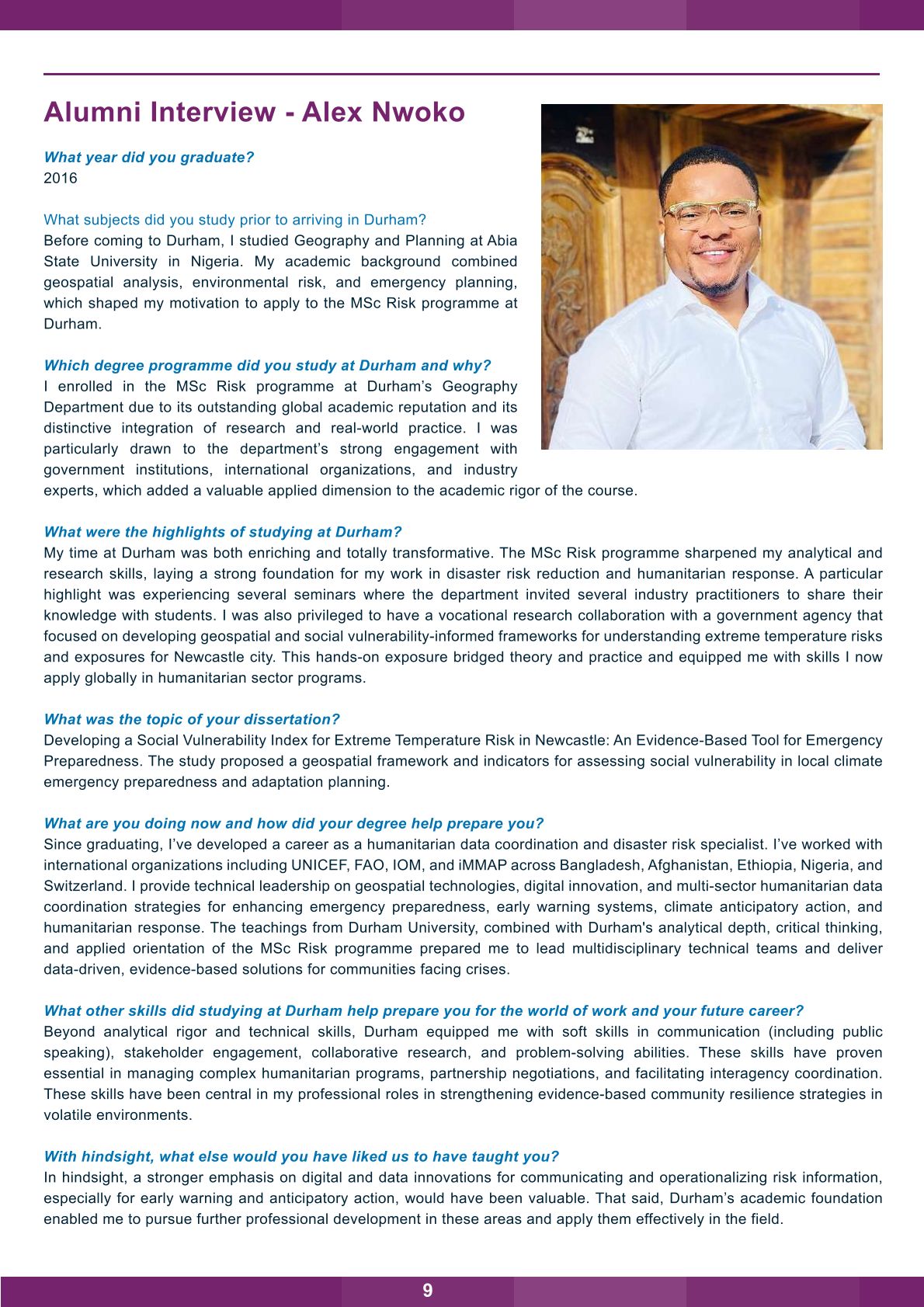
Durham University Geography Department Alumni Newsletter
Department of Geography
Summer 2026 · p. 9
Alumni interview on the arc from Durham geography and the Institute of Hazard, Risk and Resilience into a decade of humanitarian data systems architecture across Afghanistan, Bangladesh, Ethiopia, and Nigeria.
Read the newsletter (page 9) ↗
Durham University PGT Careers Event
Institute of Hazard, Risk and Resilience (IHRR)
28 November 2023 · Durham, UK
Invited by the Department of Geography and IHRR to present on making a difference through humanitarian career pathways. Presented to postgraduate students from three Risk Masters programmes alongside professionals from IBM, AECOM, Marsh, and UK Health Security Agency.
Durham University IHRR Careers Page
Institute of Hazard, Risk and Resilience
Official university website
“Everything in the humanitarian space is driven by evidence. It all rests on understanding risk and vulnerability: this is where you can flourish.”
Quoted as a featured graduate on the university’s official careers and employability page.
View on Durham UniversityPublished Work
Reports, Dashboards & Platforms
Analytical products published through UN coordination platforms, used by humanitarian country teams and donor agencies for strategic planning and resource allocation.